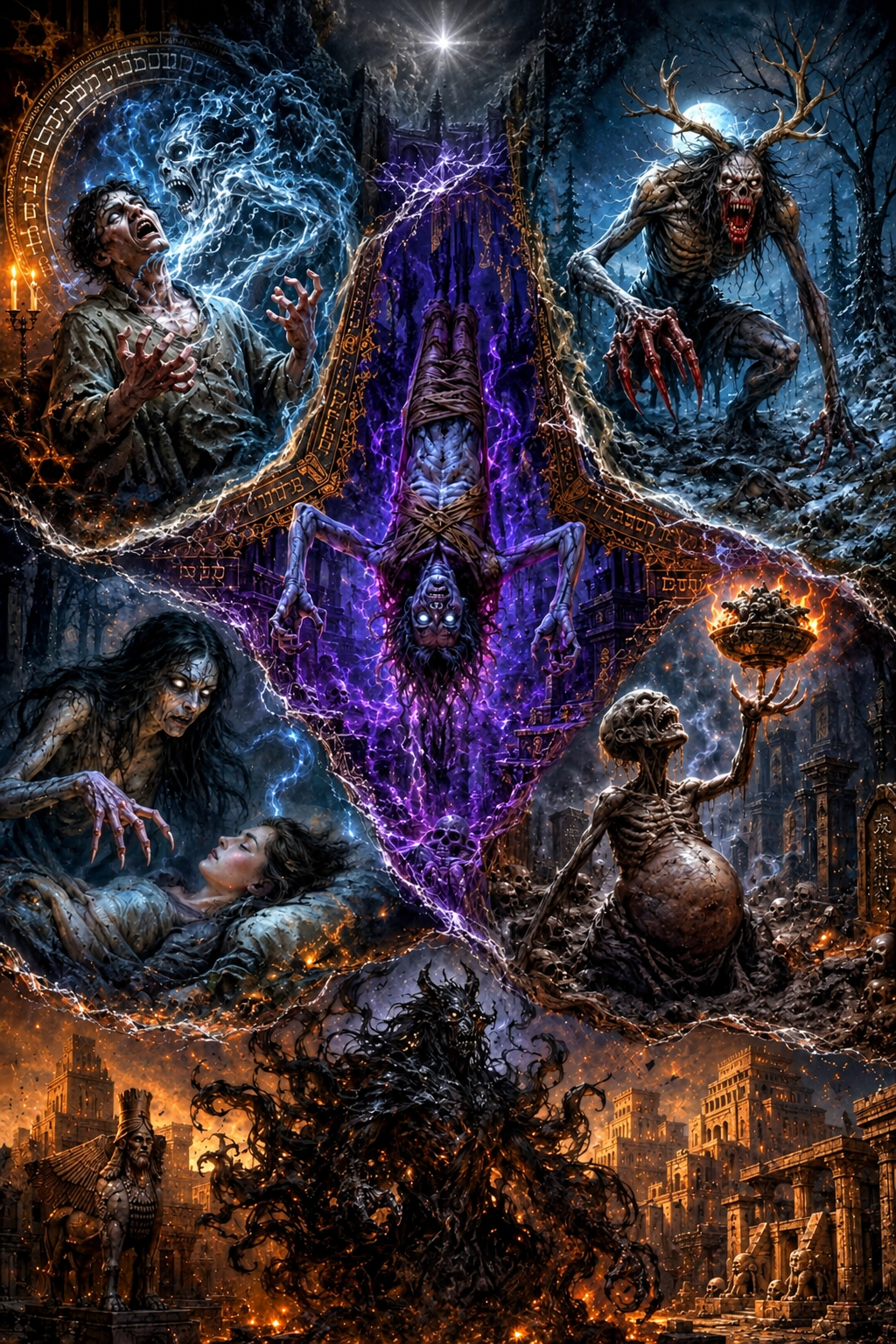
Across human history, people have looked into the darkness and imagined what might be waiting there.
Before modern science explained many of the world’s mysteries, communities created stories to make sense of the unknown. Strange sounds in the forest, unexplained illnesses, terrifying dreams, dangerous animals, storms, death, and the mysteries of the night all became part of humanity’s storytelling traditions.
From African spirits and shape-shifting creatures to European monsters, Japanese yōkai, and the supernatural beings of Indigenous traditions, almost every culture has stories about forces that exist beyond the ordinary world.
These legends are not simply frightening tales. They often reveal what different societies feared, respected, and struggled to understand.
When Darkness Became a Story
Night has always carried a special place in human imagination.
Without electricity or modern technology, darkness once transformed familiar landscapes into places of uncertainty. A forest that seemed peaceful during the day could become mysterious after sunset. A river could become a place of danger. A lonely road could inspire stories about spirits and supernatural travelers.
Stories helped communities explain these dangers.
Some creatures were said to punish people who broke social rules. Others protected sacred places or natural environments. Some were believed to represent death, disease, greed, jealousy, or human temptation.
In this sense, monsters were often mirrors of humanity itself.
Africa: Spirits, Tricksters and the Supernatural
African mythology contains an extraordinary variety of supernatural traditions, reflecting the continent’s enormous cultural diversity.
Among different peoples, stories describe spirits connected to forests, rivers, ancestors, animals, and other aspects of the natural world. These traditions vary greatly from one community to another and should not be treated as a single mythology.
In West African storytelling, supernatural figures can sometimes serve as protectors, tricksters, warnings, or explanations for mysterious events. The trickster tradition is particularly important in many cultures, where cleverness and intelligence can be more powerful than physical strength.
Stories involving supernatural beings also frequently carry moral lessons: respect elders, protect the community, avoid arrogance, and understand that actions have consequences.
The frightening element is often only part of the story.
Europe: Dragons, Witches and Creatures of the Night
European folklore contains some of the world’s most famous legendary creatures.
Dragons appear in many traditions, although their characteristics differ considerably. In some European stories, they are enormous, destructive beasts guarding treasure or threatening entire communities.
Other legends introduced people to witches, werewolves, vampires, and mysterious forest creatures.
The werewolf, for example, became associated with the frightening idea that an ordinary human being could transform into something wild and uncontrollable.
Vampire folklore similarly reflects longstanding fears surrounding death, disease, and the unknown.
Over centuries, writers, artists, filmmakers, and storytellers transformed these traditions, giving them new identities in popular culture.
Japan: Yōkai and the Spirits Around Us
Japanese folklore offers another fascinating perspective on the supernatural.
The word yōkai refers broadly to supernatural beings, mysterious phenomena, and strange creatures found throughout Japanese tradition.
Some yōkai are frightening. Others are mischievous, humorous, bizarre, or even helpful.
One important feature of these stories is the idea that the ordinary world can contain hidden supernatural dimensions. A strange sound, an unusual animal, an abandoned building, or a mysterious event could become part of a larger story.
Rather than simply dividing the world into “good” and “evil,” Japanese folklore often presents supernatural beings with complicated personalities and behaviors.
That ambiguity makes many of the legends particularly fascinating.
The Creatures of the Forest
Forests appear repeatedly in mythology around the world.
They represent life, mystery, danger, and the unknown.
In European folklore, stories developed around mysterious forest beings and wild creatures. In other cultures, forests were considered sacred spaces inhabited by spirits or supernatural guardians.
These stories may have served practical purposes as well.
A warning about a dangerous creature living deep in the forest could encourage children not to wander too far from their communities. A story about a spirit protecting a sacred grove could discourage people from destroying an important natural environment.
Mythology sometimes turned environmental wisdom into unforgettable stories.
Water: Beautiful, Powerful and Dangerous
Rivers, lakes, oceans, and waterfalls have inspired some of the world’s most haunting legends.
Water gives life, but it can also take life.
Across different cultures, stories developed around mysterious beings living beneath the surface. Some were described as beautiful and alluring, while others were portrayed as dangerous creatures capable of dragging unsuspecting travelers into the water.
These legends reflect a simple human truth: nature can be both beautiful and unpredictable.
A calm river may appear peaceful, but beneath its surface can exist currents, depths, and dangers that cannot be seen.
Mythology gave those unseen dangers a face.
Why Do We Create Monsters?
Perhaps the most interesting question is not whether legendary creatures exist.
It is why humans create stories about them.
Monsters often represent something we cannot easily explain.
A creature that hides in darkness may represent our fear of the unknown. A shape-shifter may represent uncertainty about identity. A giant predator may represent the dangers of nature. A spirit that punishes wrongdoing may represent society’s moral boundaries.
In other words, mythology gives abstract fears a physical form.
Instead of simply saying, “Be careful of the unknown,” a culture might tell the story of something living beyond the edge of the village.
The lesson becomes easier to remember.
Legends Change, But They Rarely Disappear
Modern technology has changed the way people understand the world, but mythology has not disappeared.
Instead, it has evolved.
Ancient spirits have become characters in films. Legendary monsters appear in video games, novels, television series, comics, and social media. Traditional folklore continues to inspire modern horror and fantasy.
Yet there is an important difference between studying mythology and treating every legend as historical fact.
These stories belong to cultural traditions. Their value often lies in what they tell us about the people who created, preserved, and transformed them.
They reveal fears, values, beliefs, relationships with nature, and ideas about life and death.
The Darkness Tells Us Something About Ourselves
The darker side of mythology is not simply a collection of frightening creatures.
It is a record of humanity’s imagination.
Every monster has a story.
Every spirit reflects a belief.
Every mysterious creature represents something that once captured the human imagination.
Whether found in an African village story, a European legend, Japanese folklore, Indigenous traditions, or modern popular culture, supernatural tales remind us that humans have always searched for meaning in the unknown.
Perhaps that is why these stories continue to survive.
The world may become more technologically advanced, but there will always be mysteries beyond the light—and wherever there is mystery, humanity will continue to tell stories about what might be waiting in the darkness.





Leave a Reply