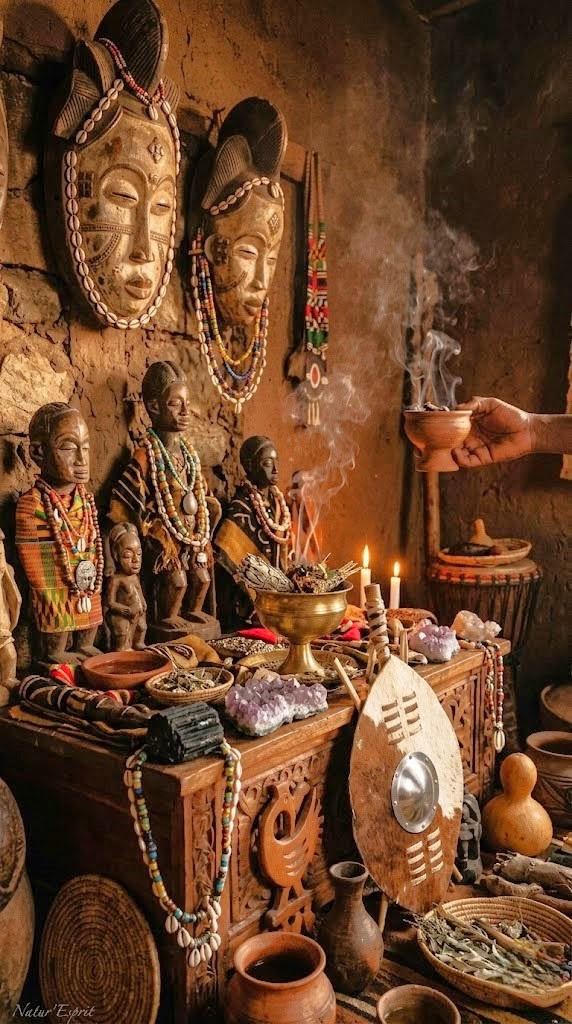
Across the African continent, long before the arrival of colonial powers and organized world religions, communities developed rich systems of spiritual belief and healing that endure to this day. These traditions are not a single, unified practice but a vast mosaic — thousands of distinct cultures, each with its own cosmology, rituals, and healers. Understanding this diversity, rather than flattening it into a single stereotype, is essential to appreciating the depth of African spiritual heritage.
A Note on Language
The word “shaman” originates from Siberian Tungusic traditions and has, over the past century, been applied loosely by outsiders to spiritual practitioners around the world, including in Africa. Many scholars and practitioners consider this term imprecise when used in an African context. More accurate terms vary by region and culture: sangoma and inyanga among Nguni-speaking peoples of Southern Africa, babalawo among the Yoruba of West Africa, nganga in Central Africa, and dozens of other titles specific to individual ethnic groups and languages. This piece uses “traditional healer” as a general term while recognizing that each tradition has its own name, structure, and meaning.
The Role of the Traditional Healer
In many African societies, the traditional healer occupies a position that Western frameworks often struggle to categorize, because it blends roles that Western culture tends to separate: physician, psychologist, priest, and community counselor. Healers are typically consulted not only for physical ailments but for matters of misfortune, relationship conflict, infertility, and spiritual imbalance.
Becoming a healer is rarely a matter of simple training. In many traditions, the calling is understood to come through the ancestors themselves — often signaled by a period of illness, vivid dreams, or psychological disturbance that only resolves once the individual accepts their spiritual path. This initiation process, which can last months or years, typically involves an experienced healer mentoring the initiate in herbal knowledge, ritual practice, and the interpretation of spiritual messages.
Ancestors and the Spirit World
Central to most traditional African belief systems is the conviction that the boundary between the living and the dead is porous rather than absolute. Ancestors are widely believed to remain active participants in the lives of their descendants — offering guidance, expressing displeasure, or requiring acknowledgment through ritual and offering.
This is not typically understood as worship in the sense practiced toward a supreme deity, but rather as a relationship of ongoing respect and communication, similar in function to how other cultures maintain a connection with deceased family members through memory and tradition. Divination — through bones, shells, water, or dreams — often serves as the primary method by which healers interpret messages from this unseen world and relay guidance to those who seek it.
Herbal Knowledge and Natural Medicine
Alongside their spiritual role, traditional healers across Africa hold extensive botanical knowledge, developed and refined over countless generations. Plants, roots, and barks are used to treat everything from common ailments to complex chronic conditions, and this accumulated knowledge has, in some cases, informed modern pharmacology — several drugs used in conventional medicine today trace their origins to plants first documented by traditional healers.
The World Health Organization estimates that a substantial share of the population in many African nations relies on traditional medicine as a primary source of healthcare, particularly in rural areas where access to formal medical infrastructure remains limited. This has prompted growing efforts, in countries such as South Africa and Ghana, to formally recognize and regulate traditional healing practices alongside conventional medicine, rather than treating the two as entirely separate systems.
Coexistence With Introduced Religions
Christianity and Islam arrived in different parts of Africa at different points in history and now represent the majority faiths across much of the continent. Yet rather than fully displacing older spiritual systems, these religions have frequently coexisted and blended with them. It is not uncommon for individuals to attend church or mosque while also consulting a traditional healer in times of illness or crisis — a form of religious pluralism that reflects pragmatic, layered belief rather than contradiction.
This syncretism varies enormously by region and community, and generalizing about it risks oversimplifying deeply personal and locally specific practices.
Challenges and Contemporary Debates
Traditional healing in Africa today exists within a complex and sometimes contested landscape. Some practices have drawn scrutiny and criticism, including instances of exploitation of vulnerable individuals or harmful pseudo-medical claims made by unqualified practitioners. Governments and health organizations continue to grapple with how to preserve legitimate cultural and medical knowledge while protecting the public from harm.
At the same time, there is a growing movement — among scholars, healthcare policymakers, and communities themselves — to document, formalize, and integrate traditional practices with modern medicine, rather than dismissing them as superstition. This reflects a broader shift toward recognizing indigenous knowledge systems as valuable rather than simply “pre-modern.”
A Living Tradition, Not a Relic
Traditional healing and spiritual belief in Africa are not static remnants of the past. They continue to adapt, evolve, and hold meaning for millions of people navigating both ancient questions of meaning and mortality and thoroughly modern challenges of health, identity, and community. Approaching these traditions with curiosity and respect — rather than exoticism or dismissal — opens a window into one of humanity’s most enduring and varied spiritual inheritances.


Leave a Reply