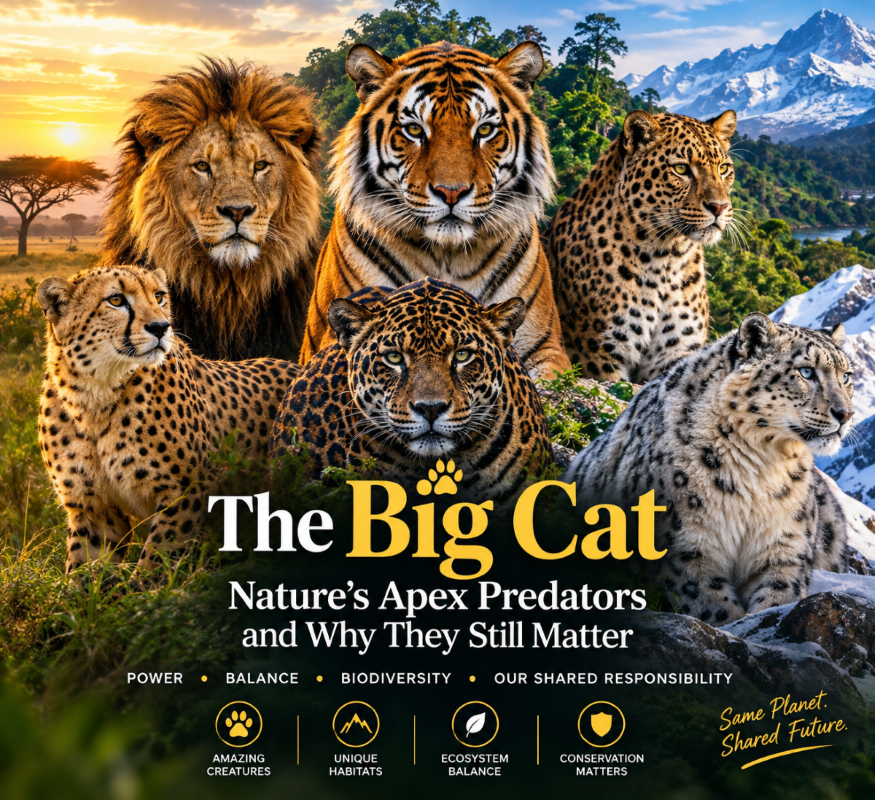
From the sun-scorched savannas of East Africa to the frozen taiga of the Russian Far East, big cats have prowled the earth’s wildest corners for millions of years. Lions, tigers, leopards, jaguars, cheetahs, and snow leopards represent some of the most powerful, adaptable, and awe-inspiring creatures on the planet. Yet today, nearly every species faces mounting pressure from habitat loss, poaching, and human conflict. Understanding what makes these animals so remarkable — and so vulnerable — has never been more urgent.
What Defines a Big Cat
The term “big cat” generally refers to the largest members of the Felidae family, most of which belong to the genus Panthera: lions, tigers, jaguars, and leopards. Cheetahs and snow leopards are often included in the group as well, even though they fall into separate genera. What unites them is not just size but a shared arsenal of evolutionary advantages: retractable claws, powerful jaws, acute night vision, and in most cases, the ability to roar — a trait unique to Panthera species, made possible by a flexible hyoid bone in the throat.
Each species has carved out its own ecological niche:
Lions are the only truly social big cats, living in prides and relying on cooperative hunting.
Tigers, the largest of all cats, are solitary and territorial, with the Siberian tiger capable of exceeding 300 kilograms.
Leopards are masters of adaptability, thriving from African grasslands to Asian mountains and even the outskirts of major cities.
Jaguars dominate the dense forests of Central and South America, prized for their bite force — the strongest relative to body size among big cats.
Cheetahs trade raw power for speed, reaching up to 100 km/h in short bursts to outrun prey.
Snow leopards are built for altitude, surviving in the thin air of the Himalayas with dense fur and oversized paws for gripping icy terrain.
Why Big Cats Matter Beyond Their Beauty
Big cats are apex predators, meaning they sit at the top of their food chains. Their presence — or absence — has cascading effects on entire ecosystems, a phenomenon ecologists call a “trophic cascade.” When big cat populations decline, herbivore numbers can surge unchecked, leading to overgrazing, vegetation loss, and long-term degradation of the habitats that countless other species depend on.
In this sense, protecting big cats is not simply a matter of sentiment. It is a matter of ecological stability. A landscape with healthy predator populations is, more often than not, a landscape in balance.
A Species Under Siege
Despite their power, big cats are remarkably fragile in the face of modern pressures:
Habitat loss from agriculture, logging, and urban expansion has fragmented territories that many species need to roam and hunt.
Poaching continues to fuel illegal wildlife trade, driven by demand for pelts, bones, and other body parts.
Human-wildlife conflict rises as shrinking habitats push cats closer to farms and villages, often resulting in retaliatory killings.
Climate change is beginning to reshape prey distribution and water availability, particularly for species like the snow leopard.
The numbers reflect this pressure. Wild tiger populations, once estimated in the hundreds of thousands a century ago, dropped to roughly 3,900 individuals by recent counts, though conservation efforts in countries like India and Nepal have helped stabilize and even grow some populations in the past decade. Lions have disappeared from over 90 percent of their historic range across Africa. Cheetahs, once found across most of Africa and parts of Asia, now occupy a fraction of their former territory.
Conservation: Reasons for Cautious Optimism
The picture is not without hope. Community-based conservation programs, anti-poaching initiatives, and habitat corridors connecting fragmented territories have shown measurable success in several regions. India’s tiger reserves, Namibia’s communal conservancies, and cross-border wildlife corridors in Central Asia all demonstrate that coexistence between big cats and human development is achievable with the right investment and political will.
Technology has also become a valuable ally. Camera traps, satellite collar tracking, and AI-assisted image recognition now allow researchers to monitor elusive species with far greater precision than in decades past, informing conservation strategy with real data rather than estimates alone.
The Bigger Picture
Big cats occupy a unique place in the human imagination — symbols of power, freedom, and wildness across cultures and centuries. But their value extends well beyond myth and metaphor. They are indicators of ecosystem health, drivers of biodiversity, and, increasingly, a test of whether humanity can share the planet with the species it has long admired from a distance.
Their future is not yet decided. It will be shaped by the choices made in the coming decades — in policy, in land use, and in the everyday decisions of the communities who share their habitat. Whether the roar of the tiger and the silent stalk of the leopard remain part of our world is, in the end, a choice still within our reach.


 The Blind Man Society
Leave a comment